Which Studies About AI Search No Longer Hold – and How to Spot Them
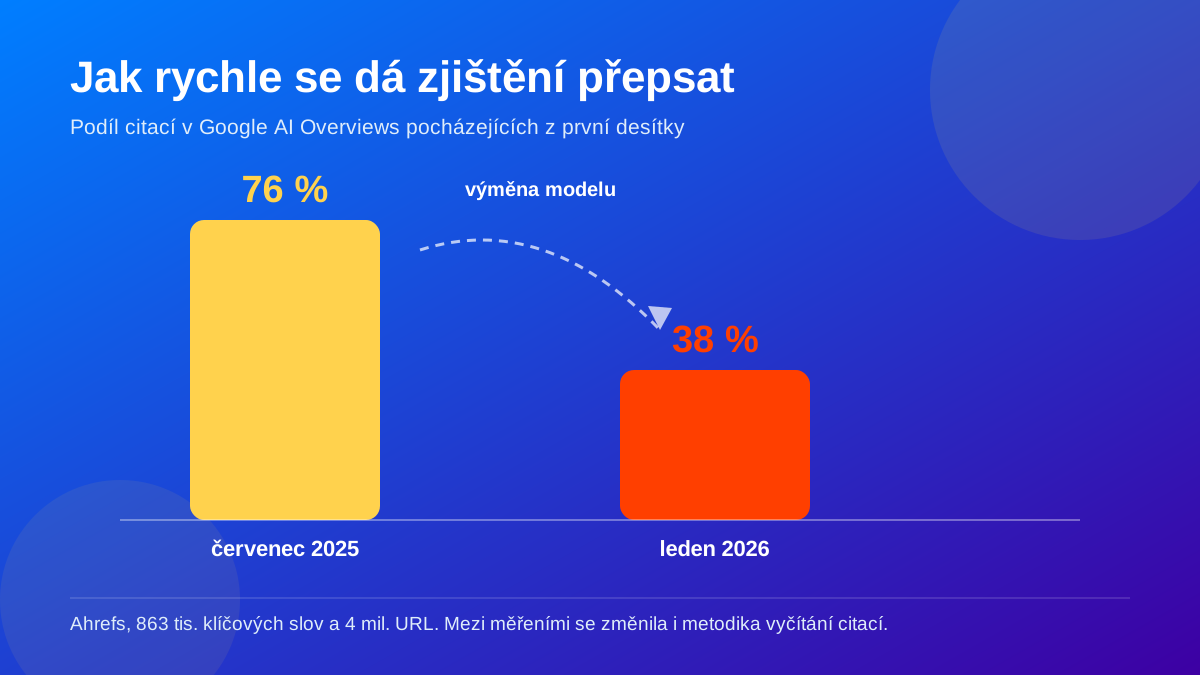
The most dangerous number in SEO is not the wrong one. It is last year’s correct number. The share of citations from Google’s top ten dropped from 76 to 38 percent within half a year after a model swap – and that is just one example. An overview of findings that no longer hold, those that survived, and a guide to reading studies so they do not age in your hands.
More data is cited in SEO today than ever before. The problem is not that it is made up – mostly it is honest. The problem is that it has a half-life and nobody states it. A number measured last July can today be not just outdated but outright misleading, because somebody swapped the model in the meantime.
This text is an attempt at an inventory: what no longer holds, what survived, and how to tell which category a new number belongs to.
Why it ages faster than before
A classic SEO finding had a lifespan measured in years. Google changed gradually, core updates came a few times a year and between them you could build on what you had measured.
Generative search, however, changes in leaps. When the operator swaps the model behind the answers, overnight not only the quality of the text changes but also where it takes its sources from. No change you made to your website has anything to do with it – and yet everything you knew about citability shifts.
The best documented example: in July 2025, 76% of citations in Google AI Overviews came from pages in the top ten results. Half a year later, after a new model was deployed, it was 38% – measured on 863,000 keywords and 4 million URLs. Whoever planned in January 2026 by last year’s number planned by half.
And let us add right away what most articles quoting it left out: the authors meanwhile refined the way they extract citations from answers. Part of that difference is therefore made not by the model but by the methodology. Even “ageing” can be overdone.
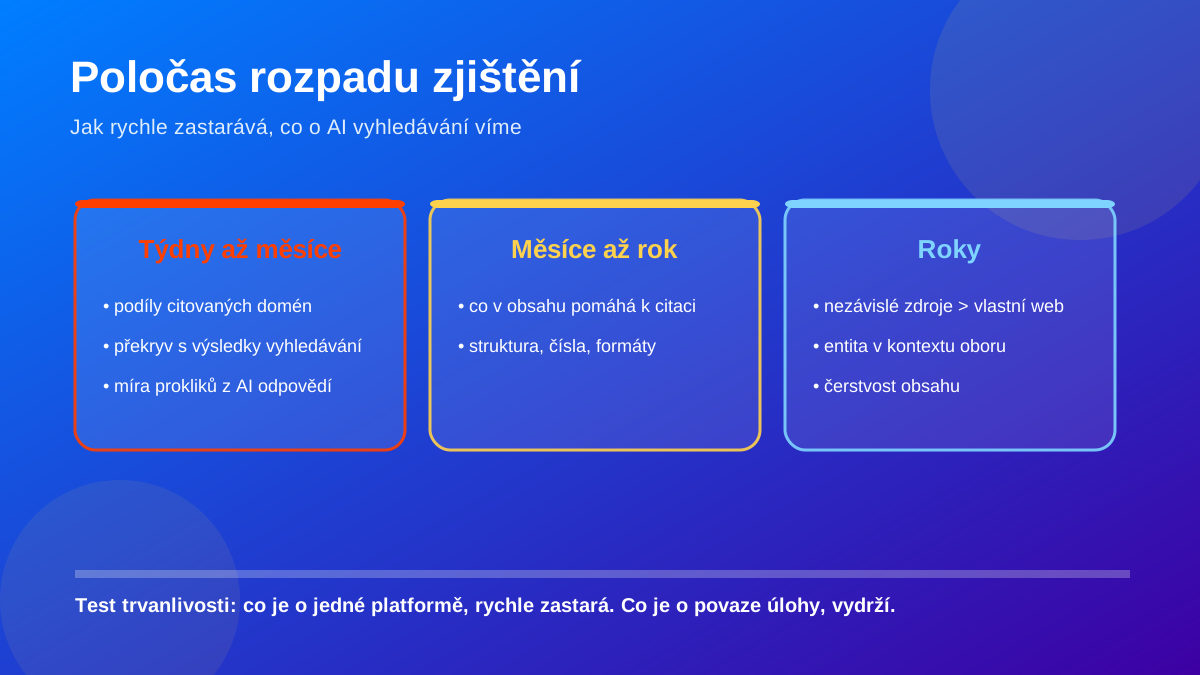
Three bands of durability
More useful than sorting studies into old and new is asking how deep the finding reaches:
- Weeks to months. Anything describing the behaviour of a specific platform: shares of cited domains, overlap with search results, click-through rates from AI answers. This is a snapshot, not a law.
- Months to a year. What in content helps toward a citation – structure, numbers, formats. It changes more slowly because it relates to how models process text in general.
- Years. Structural findings that follow from the nature of the task, not from a specific model. Those survive even a whole generation swap.
What no longer holds
The specific percentages from the GEO study (KDD 2024). This is the most cited research in the field and at the same time the most overused. It did not run on live ChatGPT: it was an offline pipeline with its own visibility score built on evaluation by a GPT-3.5-generation model, partly over invented catalogues. A critical 2026 review of GEO adds that in such a setup the effect of content edits gets confused with search noise. The direction holds and keeps being confirmed – statistics, quotes and cited sources help, keyword density does not. But numbers like “+41%” or “+115%” are laboratory values from spring 2024 and should not be cited as today’s expectations.
Anything about AI Overviews from before January 2026. See the example above. This includes all the derived advice of the “just be in the top 10” kind.
Click-through curves from before AI answers. Tables like “the first position takes about thirty percent of clicks” still appear in agency offers. Meanwhile Pew Research Center measured a drop in the share of searches in which a person clicked any link at all from 15% to 8%. The old curve does not describe today’s results page.
Tables of “which model cites from where”. Shares like “Perplexity takes half from Reddit” move with licensing deals and index changes. Between November 2025 and February 2026, LinkedIn moved on professional queries from outside the top twenty to the most cited domain of all. Treat any figure older than two quarters as an illustration, not as a basis for a decision.
“ChatGPT runs on Bing.” Advice built on the idea that ranking well in Bing is enough arose at a time when it worked that way. The search layer has changed since.
llms.txt as a visibility tool. This is the rare case where a recommended practice was simply disproved. An analysis of roughly 300,000 domains found no relationship between the file’s presence and citability in answers. Another analysis of 137,000 websites found that 97% of those files did not get a single visit in a month. Google explicitly states you do not need it for AI Overviews or AI Mode. Having it does no harm, but selling it as a service does.
Link-building studies from two years ago that make links the main factor. The weight of links has shifted and a risk was added that did not exist before: since 2024 Google enforces the site reputation abuse policy. Advice like “publish on someone else’s strong domain, it works great” turned from a tip into a risk.
What, by contrast, survived every model swap
- Third parties weigh more than your own website. It is not a property of the model but the nature of the task: a brand’s claim about itself gives the model nothing to lean on. This has held from the first measurements to this day.
- What decides is the name spoken in the context of the field. The model associates an entity with what is written about it where – not with how many links it has.
- Freshness. Across platforms it holds that citations point predominantly to recent content.
- Source selection is not strictly by ranking. That is why smaller websites have a chance in generative search they do not have in the classic one.
Notice what they have in common: none of them is about one platform. That is a fairly reliable durability test.
Five questions to ask about every study
- When was it measured, not when was it published. The difference tends to be half a year and in this field that is an abyss. A study without a measurement date is incomplete.
- Did the methodology change in the meantime? Two numbers from the same author need not be comparable even when they look like a trend. Honest studies state it themselves – and quoting articles usually cut it.
- Who paid for it? Most data in the field comes from tool vendors. That does not disqualify them, but they measure on their own indexes and with their own metrics.
- Is it correlation or causation? Big brands have many links, much traffic and many mentions at once. Correlation will not tell you which of these causes what.
- Does it hold for your market too? Almost all data comes from the English-speaking environment. Czech or Polish results behave differently if only because there is less competing content in them.
The one number that will not age
The one number that will not age is your own measurement on a fixed set of queries.
Build a fixed set of 20 to 30 queries your customers actually deal with, and once a month go through whether the models name you in the answers and what they refer to. It takes half an hour.
That single spreadsheet is more valuable for your decisions than all the research combined – because it measures your brand, in your niche, on today’s models. Use studies for what they are good at: hinting at what to try. Not as proof that it works.
Summary in five sentences
- Data about AI search has a half-life. The more specific the platform it concerns, the shorter.
- A model swap rewrites the results overnight – regardless of what you did with your website.
- Ask for the measurement date, not the article’s publication date.
- What is about one platform ages fast. What is about the nature of the task endures.
- Your own measurement beats every study, because it asks about your brand and today’s models.
A final note that applies to this article too: the numbers in it reflect the state as of August 2026. Remember it in a year and some of them will look as naive as the ones we are writing off today. That is not a failure of the field – that is its pace. Which is why on the Linketica marketplace we show concrete parameters and prices for media instead of promises about algorithms: those can be verified today and will still hold next year.
Časté otázky
How do I tell a study about AI search is outdated?
Does the GEO study from KDD 2024 still hold?
Why did the share of citations from Google’s top ten drop from 76% to 38%?
Does it make sense to have llms.txt on the website?
Can anything in this data be trusted at all?
What to measure instead of adopting other people’s numbers?
Zdroje a doporučená literatura
- Ahrefs – překryv citací AI asistentů s výsledky vyhledávání (15 000 promptů)
- Optimizing Visibility in Generative Engines: A Critical Survey of GEO (2023–2026), arXiv
- Search Engine Journal – llms.txt bez měřitelného vlivu na citovanost (analýza ~300 000 domén)
- Pew Research Center – Google users are less likely to click on links when an AI summary appears (2025)
Zjistěte zdarma, jak vás vidí AI
Nechte jméno, e-mail a telefon a odemkneme vám online audit AI viditelnosti + checklist „Doporučuje vás AI?“ ke stažení.
Chcete rovnou nakupovat PR články a zmínky? Vyzkoušet Linketicu · Nezávazná poptávka na míru
Zadáním kontaktu souhlasíte s jeho použitím pro zpřístupnění auditu a zaslání tipů. Údaje nepředáváme dál. · Linketica.com