Do Backlinks Help in AI Search? What 129,000 Domains Say
An analysis of 129 thousand domains found the strongest predictor of who ChatGPT cites: the number of referring domains. Yet other studies show citations overlap with Google rankings by only about a tenth. We go through what we actually know about the role of links in AI search – and where the limits are.
Two contradictory things are said about links in connection with AI search. Some claim link building is dead because a language model uses no link graph. Others sell link packages with the promise that ChatGPT will start citing you thanks to them. Both are inaccurate, and fortunately we no longer have to settle it by impression – several extensive data analyses exist. We go through them in order, including what they disprove.
First the mechanism: the model does not see the link attribute
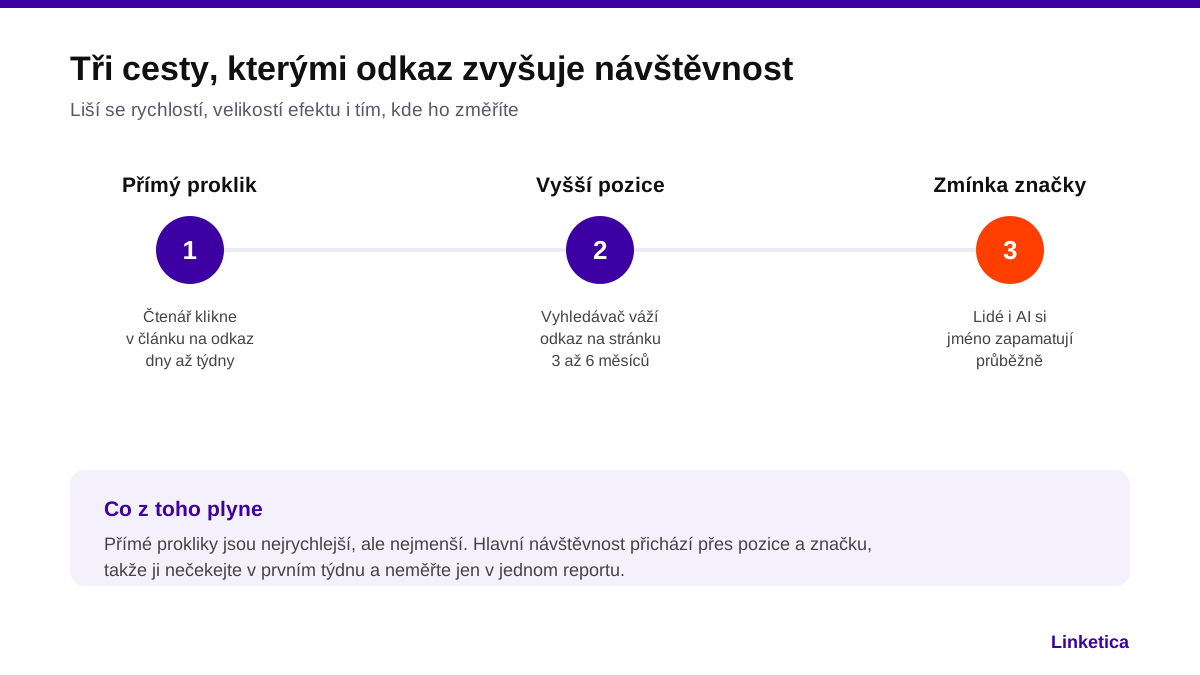
A language model, when assembling an answer, does not work with whether a link is follow or nofollow. It has no PageRank and does not track who links to whom. It reads the text the search layer hands it. Links therefore enter the game indirectly, by three routes:
- Through the search index. ChatGPT Search and Google AI Overviews build the answer on search results whose ranking uses links. A stronger link profile raises the chance the page gets into the selection the model draws from at all.
- Through content discovery. A linked page is found faster and visited more often – by people and by bots.
- Through the text around the link. That is, through the brand mention. As you will see, this third route is the strongest of them.
The question “do links help AI visibility” therefore splits into two different ones: whether the domain’s link profile helps, and whether the specific attribute on a specific link helps. Both now have an answer backed by data – and for the second one it is that the attribute does not matter. We will go through both.
Study 1: 129,000 domains and the strongest predictor of citations
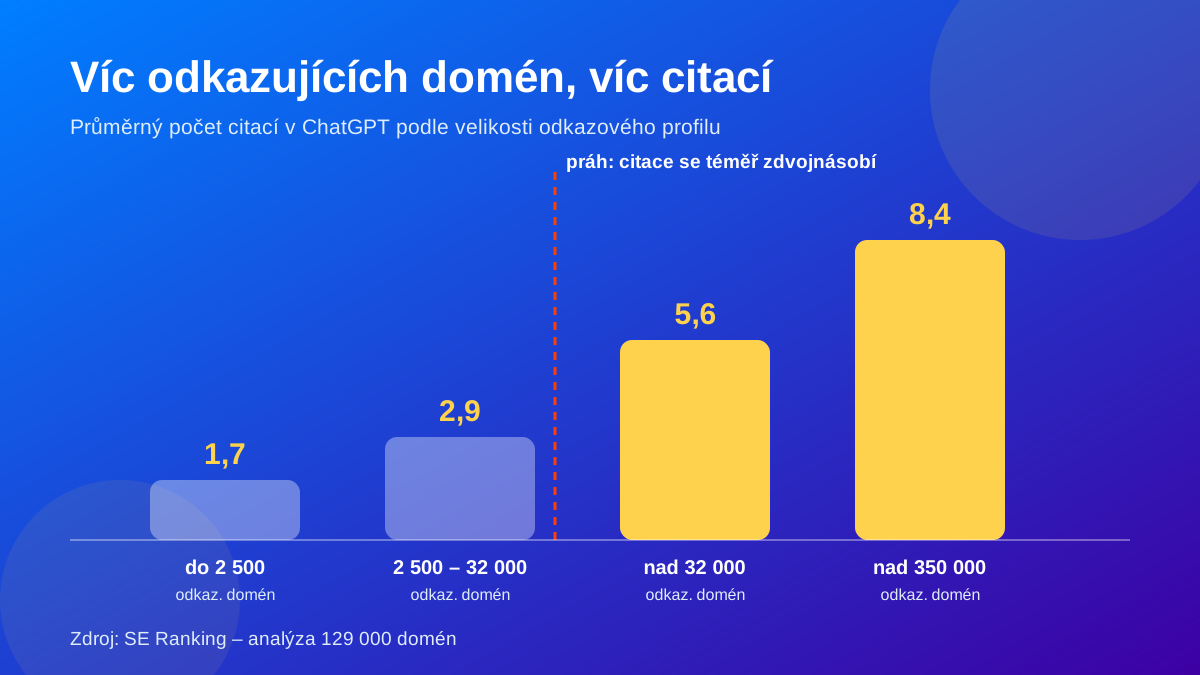
The SE Ranking analysis went through 129,000 domains and 216,524 pages in twenty niches, looking for which factors best predict that ChatGPT lists a page as a source. The model (gradient boosting over a dataset of 100,000 prompts, interpreted with SHAP) delivered good news for link building advocates: the number of referring domains came out as the single strongest predictor of all. What decides, though, is the diversity of links, not their total count.
More interesting than the ranking of factors are the measured thresholds:
- Domains up to 2,500 referring domains: on average 1.6 to 1.8 citations.
- The break comes around 32,000 referring domains – the citation count jumps there from 2.9 to 5.6.
- Domains above 350,000 referring domains: on average 8.4 citations.
The second strongest factor was domain traffic, but that too only showed at high values. And one finding deserves attention on its own: above Page Trust 28 there is practically no difference between pages any more – all received roughly the same rate of citations. The model thus weighs the authority of the domain, not the individual URL.
From the same analysis comes a figure that changes content planning: 95% of ChatGPT citations fall on content published in the past ten months. Pages with a visible update date moreover received roughly 1.8 times more citations than those without one.
Study 2: 126 million prompts and the difference between a mention and a citation
Semrush processed 126 million prompts from January to April 2026 across 22 industries in its AI Visibility Index 2026. It named the thing most often confused in practice: the difference between a mention (the model names your brand in the answer) and a citation (the model lists your page as a source). They are not synonyms nor two names for the same thing – the overlap of the set of mentioned brands and cited domains ranges from 64% for Google AI Overviews to a mere 30% for Gemini. It means you can win in one discipline and lose in the other: be a recommended brand but an uncited website, or vice versa. Most companies measure only one of them.
One more note on methodology: Semrush measures four platforms separately – ChatGPT, Gemini, Google AI Mode and AI Overviews – and the number of sources differs between them by an order of magnitude. ChatGPT lists on average around fifteen sources per answer, Gemini roughly three. What suffices for a citation on one platform need not on another.
Study 3: the only one that asked directly about the link attribute
The question the previous analyses leave open was answered by a separate study by Kevin Indig and Semrush: 1,000 domains and 35,000 data points across five systems (ChatGPT, ChatGPT Search, Gemini, Google AI Overviews, Perplexity). Its conclusion on volume agrees with the previous ones: the quality and authority of the referring sources decide, not their count – the strongest correlation with visibility in AI answers was held by Authority Score, a metric of link profile quality.
And then there is the finding worth knowing before every purchase: nofollow links come out practically the same as follow for AI visibility – the difference in correlation was about half a percentage point. It fits the mechanism described above: the model does not see the link attribute at all. So if you buy a link for AI visibility, paying extra for the follow variant is paying for nothing – and with paid placement, additionally for a violation of Google’s rules.
Study 4: links as a ticket, not an engine
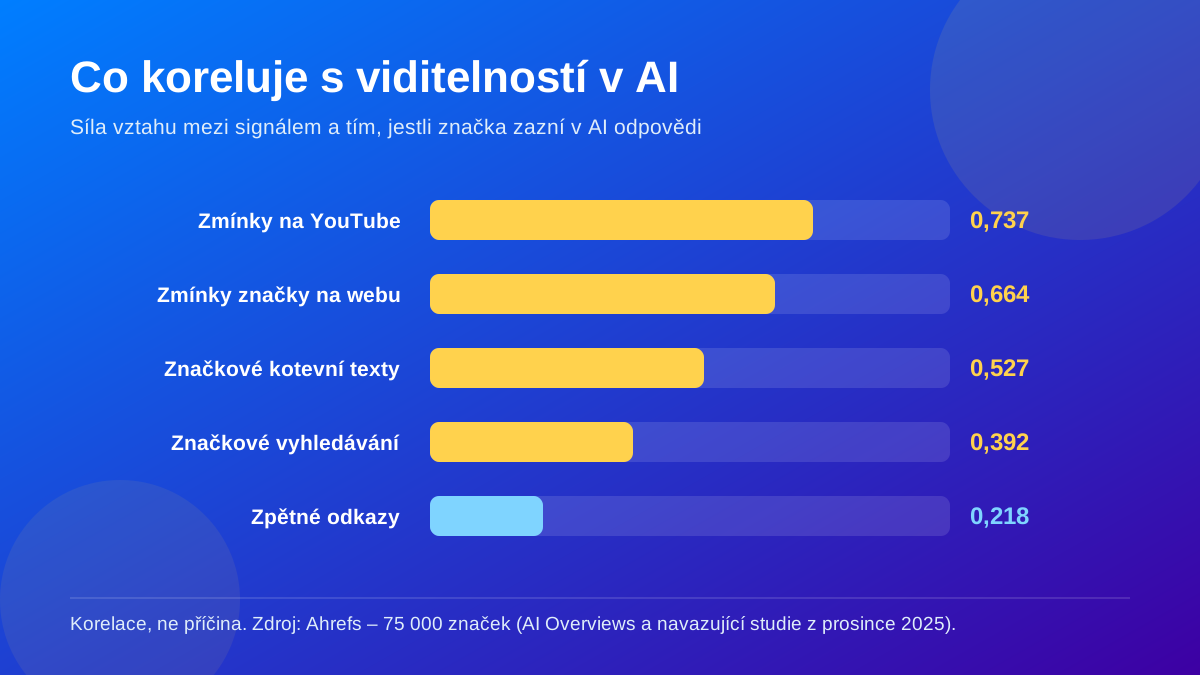
The Ahrefs analysis of 75,000 brands measured which signals predict visibility in Google AI Overviews. The ranking: brand mentions on the web 0.664, branded anchor texts 0.527, branded search volume 0.392 – and backlinks 0.218. A follow-up study from December 2025 extended the measurement to ChatGPT and Google AI Mode, and the strongest single signal in it was mentions on YouTube (0.737) – a reminder that the media mix has long ceased to be only about text websites.
This number is often quoted as proof that links do not work. The more precise reading is different: 0.218 is not zero, it is a weaker positive correlation. Across the analyses, the interpretation has settled that links work as a threshold condition – they get the domain into the set of sources the system considers at all. Who from that set finally sounds in the answer is then decided by something else: how often and in what contexts the brand is written about.
It also fits the threshold values from the first study. Links help reliably, but mainly in a band a small brand cannot reach with one purchase.
And now the counterarguments it is fair to know
- A Google ranking no longer guarantees a citation. Ahrefs put 15,000 long queries to four assistants – ChatGPT, Gemini, Copilot and Perplexity. For ChatGPT, Gemini and Copilot, only roughly 12% of cited URLs appear in Google’s top 10 for the same query; the average overlap with the top 10 of Google and Bing came out at 11%. The chain “links → better rankings → citations” thus leaks a lot.
- And it most likely leaks more and more. A larger analysis on 863,000 keywords and 4 million URLs measured that 38% of citations in AI Overviews come from the top 10, versus 76% in the previous measurement from July 2025. In timing it matches the deployment of a new model behind AI Overviews. It is fair to add that the authors meanwhile refined the way citations are extracted from answers, so the two numbers are not directly comparable and part of the difference is down to methodology. The direction, though, is confirmed by the previous point too.
- Perplexity is the exception in the opposite direction. In the same Ahrefs measurement, almost every third of its citations points to a page from the top 10 – the most of all four assistants. Perplexity draws from neither Google’s nor Bing’s index, it has its own crawler; its selection nevertheless stands on an ordinary search ranking into which domain authority enters. “AI ignores links” thus does not hold across the board even between assistants.
- Nobody has proven causality for links. The most extensive controlled experiment so far – the study What Gets Cited: Competitive GEO in AI Answer Engines from SIGIR 2026, 252,000 trials on 6 models and 18 content factors – presented the model with two sources differing in exactly one factor and watched which one it cited first. Topical relevance and position in the presented context decided. Links did not figure among the tested factors at all – only what is visible in the context can be tested.
- Measuring impact is harder than it seems. Product Hunt published a case where citability in ChatGPT grew tenfold after new content was deployed – and found retrospectively that the timing matched a model update. Whoever measures only before and after easily claims someone else’s credit.
The figures in this article reflect the state as of August 2026.
Three methodological caveats to all these numbers
- They are mostly studies by tool vendors (SE Ranking, Semrush, Ahrefs), built on their own indexes and samples. This is not independent academic research.
- They are correlational. Big domains have many links, much traffic and many mentions at once. Which of these causes citations cannot be read from a correlation.
- Most of them do not distinguish follow and nofollow. The “referring domains” metric in common tools counts both together, so nothing about the link attribute can be read from SE Ranking’s thresholds. The only study that measured it separately (Indig & Semrush) found practically no difference – but even that one is correlational and stands on one sample of a thousand domains.
What will age sooner and what later
In a year this article will not hold in full – and it is fair to say which parts. What decides is how deep the finding reaches:
- Ages first: the overlap of citations with search results and the distribution of citations between platforms. Both change with every model swap, as the drop from 76 to 38 percent within half a year shows.
- Lasts longer: the link profile thresholds. They relate to how the search index rates domains, and that changes more slowly than the models above it.
- Will most likely survive everything: that what third parties write about you decides, and that a brand mention weighs more than a link attribute. That follows not from a specific model but from the nature of the task.
What to take into practice
- Build links for the domain, not for one page. The data shows an effect at the level of the whole website; the value of an individual URL stops differentiating above a low trust threshold.
- Do not compete on volume unless you are big. The thresholds are in the tens of thousands of referring domains. A smaller brand catches up with the competition through relevance and mentions, not through link counts.
- Publish continuously and date your content. When 95% of citations fall on content younger than ten months, a one-off campaign every two years is a wasted investment. A visible update date pays off technically too.
- Measure mentions and citations separately. They are two different metrics with different causes. Track the share of answers where the model names you, and whether it links to your website.
- Do not buy by link attribute. The only measurement that compared follow and nofollow found no difference between them for AI visibility – and with paid placement a follow link additionally conflicts with Google’s rules. Ask whether the title itself is cited and whether your brand’s name sounds in the text.
- Broaden the mix beyond texts. The strongest single correlation in the Ahrefs data belonged to mentions on YouTube.
Summary in five sentences
- Links work – in the biggest analysis they are the strongest predictor of who ChatGPT cites.
- But they work as a ticket, not an engine: they get you among the considered sources; something else decides the winner.
- The authority of the whole domain decides, not the individual page. You are building a website, not one article.
- Freshness is an underrated lever. Almost all citations point to content younger than a year.
- A brand mention beats a link in every comparison that measured it.
The best news is that these two things do not exclude each other. A publication in a good medium brings both at once – a link and a mention. That is exactly why for every title on the Linketica marketplace you see its parameters and price up front: you can choose by relevance and readership, not by one number in a spreadsheet, and order the publication in one place.
Časté otázky
Do backlinks work for visibility in ChatGPT?
How many referring domains does it take to be noticeable?
Is it better to buy dofollow links?
Is getting into Google’s top 10 enough to be cited by AI?
What is the difference between a mention and a citation?
How often is it necessary to publish?
Zdroje a doporučená literatura
- SE Ranking – faktory citovanosti v ChatGPT (129 000 domén, 216 524 stránek)
- Semrush – AI Visibility Index 2026 (126 mil. promptů, leden–duben 2026)
- Indig & Semrush – How AI Really Weighs Your Links (1 000 domén, 35 000 datových bodů)
- Ahrefs – An Analysis of AI Overview Brand Visibility Factors (75 000 značek, 2025)
- Ahrefs – korelace značkových signálů s viditelností v ChatGPT a Google AI Mode (prosinec 2025)
- Ahrefs – překryv citací AI asistentů s výsledky vyhledávání (15 000 promptů)
- Ahrefs – podíl citací v AI Overviews pocházejících z top 10 (863 tis. klíčových slov, 4 mil. URL)
- Vishwakarma, Kumar, Jamidar: What Gets Cited – Competitive GEO in AI Answer Engines (SIGIR 2026)
Zjistěte zdarma, jak vás vidí AI
Nechte jméno, e-mail a telefon a odemkneme vám online audit AI viditelnosti + checklist „Doporučuje vás AI?“ ke stažení.
Chcete rovnou nakupovat PR články a zmínky? Vyzkoušet Linketicu · Nezávazná poptávka na míru
Zadáním kontaktu souhlasíte s jeho použitím pro zpřístupnění auditu a zaslání tipů. Údaje nepředáváme dál. · Linketica.com