Is Buying Links and Mentions in Editorial Articles Worth It? What the Studies Say
A paid PR article today sells two things at once: a link for SEO and a mention for language models. The data shows, though, that each works differently – and that AI refers to paid articles 0.3% of the time. We break down what research exists, where buying is advantageous and where its limits are.
The question sounds simple: does it make sense to pay for an article with a link and a brand mention, when decisions are made not only in Google but also in the answers of ChatGPT or Perplexity? The answer is not simple, because a bought article sells three different things at once – a link, a mention and a published page – and the data shows the value of each is different. Let us look at what research actually exists and what follows from it for the budget.
Is there a study on it? Yes, but not the one you would expect
A study of the type “we bought 100 PR articles and measured an X% rise in AI citations” does not publicly exist yet – and it is fair to say so up front. But there are three large datasets that together answer quite precisely:
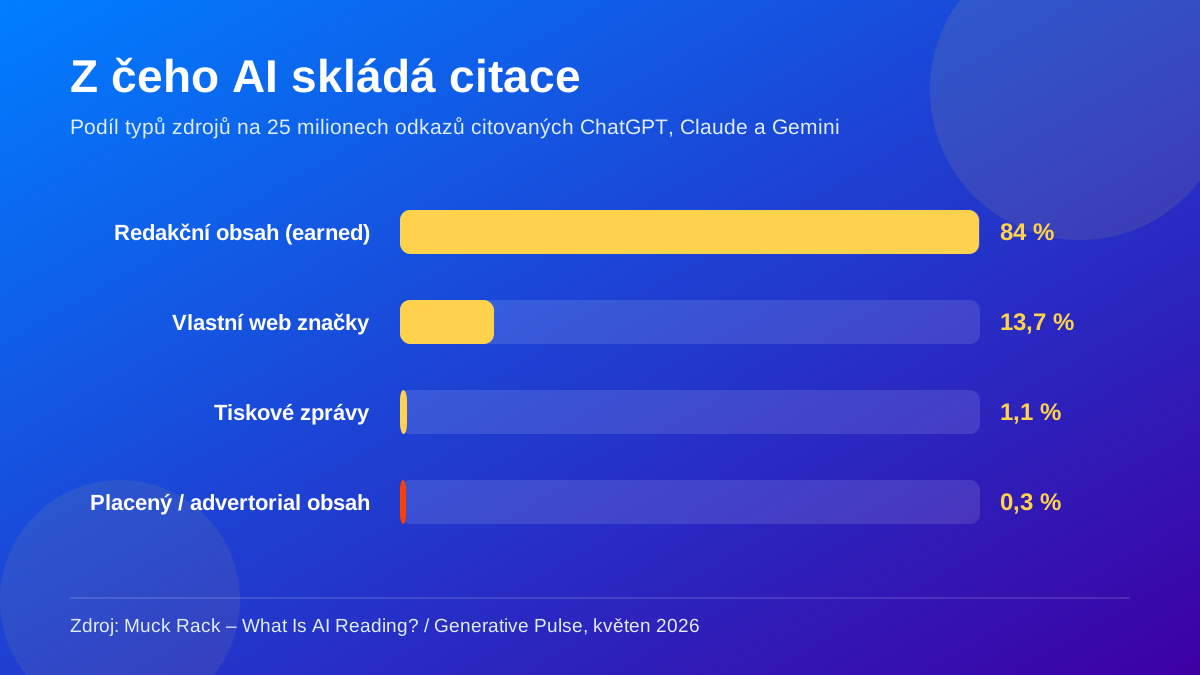
- Muck Rack: What Is AI Reading? / Generative Pulse (May 2026). An analysis of more than 25 million links cited in their answers by ChatGPT, Claude and Gemini, across 17 industries. The key number: 84% of citations fall on earned media, i.e. content nobody ordered. Across three editions since July 2025 the figure holds in the 82–89% band; journalism itself makes up roughly 27%. And then there is the figure that should interest everyone who buys PR: paid and advertorial content makes up 0.3% of all citations. Press releases 1.1%, the brand’s own website 13.7%.
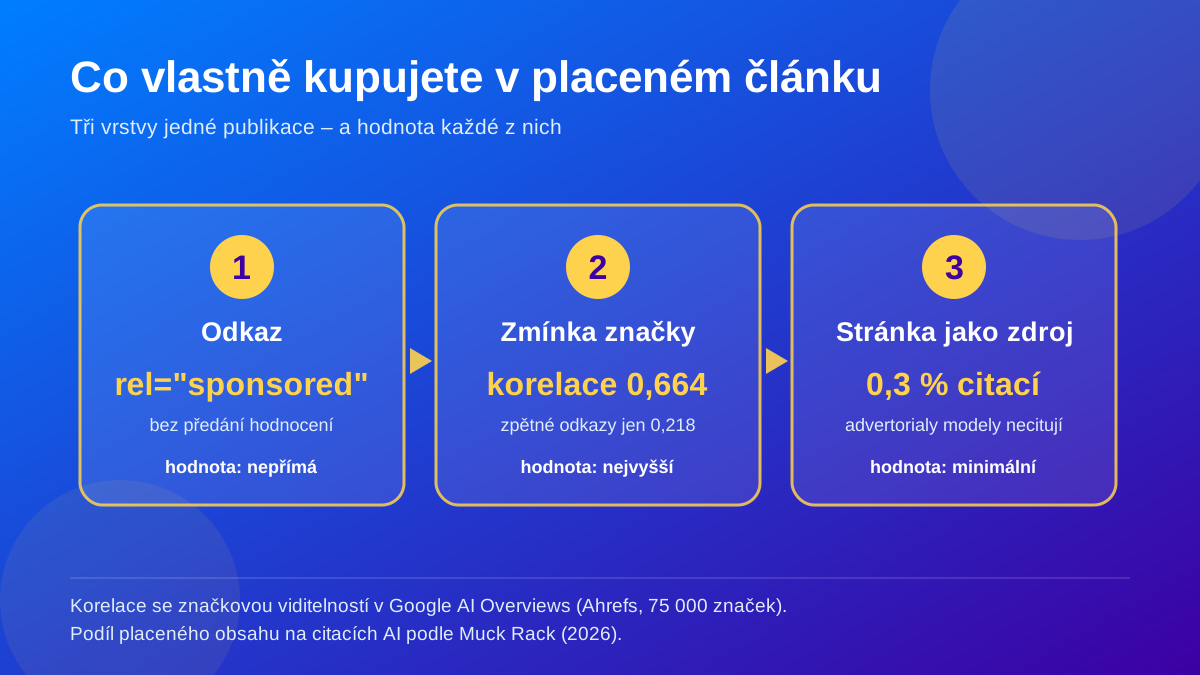
- Ahrefs: the 75,000 brands analysis (2025). It measured which signals best predict a brand appearing in Google AI Overviews. The strongest correlation goes to brand mentions on the web (0.664), followed by branded anchor texts (0.527) and branded search volume (0.392). Backlinks ended at 0.218 – roughly three times lower than plain mentions. A follow-up analysis from late 2025 measured mentions at even 0.709 for Google AI Mode.
- GEO: Generative Engine Optimization (Aggarwal et al., KDD 2024). So far the only peer-reviewed academic framework on the topic, measured on a benchmark of 10,000 queries. Nine tested text edits differed in effect: adding concrete statistics, expert quotes and cited sources raised visibility by up to 40%, while keyword density brought nothing. The biggest gains went to websites from lower positions – a page in fifth position saw visibility grow by 115%, while the hitherto first one on average declined.
The figures in this article reflect the state as of August 2026. Data about AI search ages fast – why, and how to spot it, we break down in the article about studies that no longer hold.
An honest note on the second point: correlation is not causation. Big brands have many mentions because they are big, and not necessarily the other way round. The study’s authors point this out too. Yet it is remarkable how consistently the same ranking comes out: what is written about you elsewhere weighs more than a link.
Three layers of one bought article
When you order a publication, you pay for a bundle that can be taken apart into three parts with very different value:
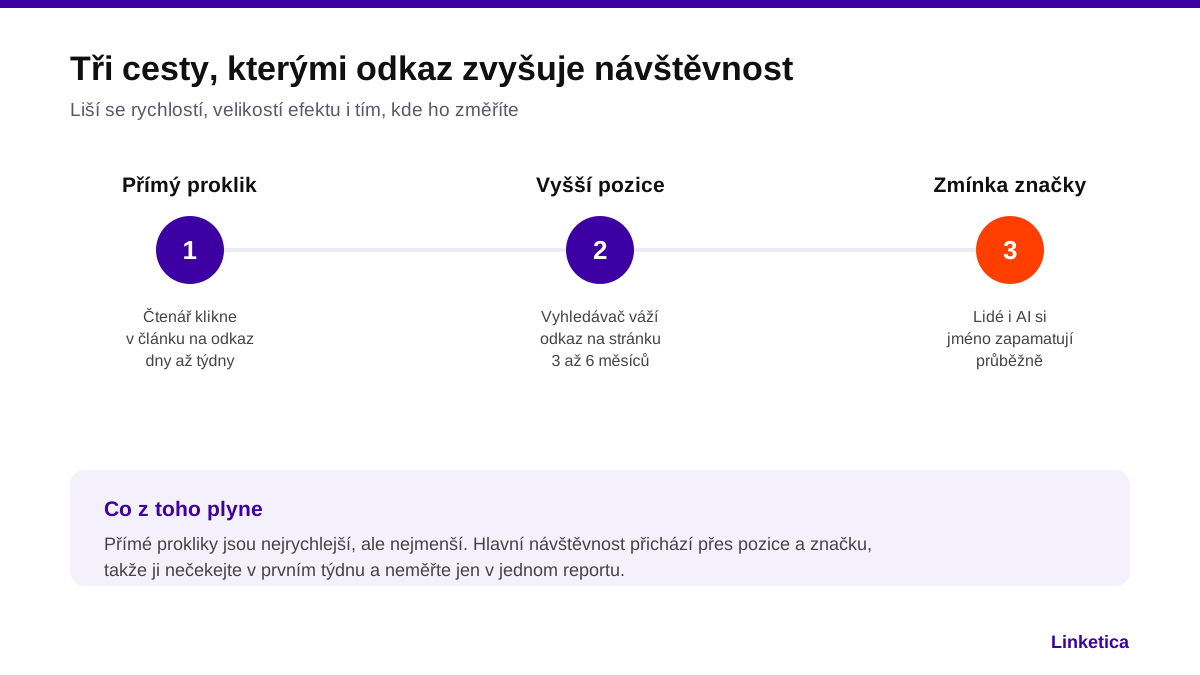
- The link. If the publication is paid, it should by Google’s rules be labelled with rel="sponsored" or rel="nofollow". Formally it therefore passes no ranking. The link’s real value is indirect – it brings people and helps content discovery.
- The brand mention in the text. This is the layer most buyers underrate, and yet it is the one that, according to Ahrefs, correlates with AI visibility most strongly. A language model reads text, not link attributes. A sentence like “sprouting seeds are sold, for example, by the e-shop Naklíčeno.cz, which delivers them within 24 hours” has value for the model even without any link.
- The page as a citable source. The hope that models will cite your paid article itself as a source is, by the Muck Rack data, small – 0.3%. Advertorials tend to be labelled, thin on content, and models do not take them as sources.
From this follows perhaps the most useful sentence of the whole article: do not buy a link, buy a mention – and buy it where somebody reads and picks it up.
Advantages of buying that the data supports
- Speed and certainty of date. Classic earned PR is a lottery: a pitch can land in a week, in a year, or never. Bought space has a publication date and a price up front. For a campaign with a seasonal window it is often the only variant that makes it in time.
- Control over the context. In an editorial text you usually cannot influence how you are described. In an ordered publication you can ensure the brand name, the industry, the location and concrete parameters are stated – exactly the attributes from which the model forms its idea of what to recommend you for.
- Accessibility for unknown brands. A journalist will not write about a company they never heard of that has nothing to say. Buying is often the only way for a small brand to get into the text space at all. The GEO study moreover shows the biggest relative gains go to those who stand low today.
- Permanence. A permanently published article works for years. Unlike PPC you do not pay for every further impression.
- Side effects that count. A mention brings referral visits and raises branded search – itself one of the signals that correlates with AI visibility in the Ahrefs analysis (0.392).
- A predictable cost. The price is known up front and a return can be calculated from it. That cannot be said of most PR activities.
Disadvantages and risks nobody talks about
- A paid article is almost never cited. The 0.3% is a hard ceiling. If somebody sells you a PR article claiming “ChatGPT will cite you”, they are selling something the data does not support. The value lies in the mention inside, not in the page itself.
- The direct SEO value of the link is close to zero with a correct publication. You are thus paying mainly for the mention and the audience, not for passed ranking. And if the medium does not label paid links, both sides take a risk: systematic buying of unlabelled follow links violates Google’s rules and is handled with a penalty on the whole domain.
- Risk on the medium’s side. Since 2024 Google has enforced the policy against site reputation abuse – against commercial third-party content published on a foreign authoritative domain without genuine editorial oversight. The most cited example is Cointelegraph: in October 2025 its organic Google traffic fell, by public estimates, by more than 90% – from millions of visits a month – and the medium shortly afterwards deleted an entire section of third-party gambling content. Google never confirmed the action and individual tools’ estimates diverge, so the connection is indirect. But the principle holds: when the medium falls, the value of your publication falls with it – and you paid for it up front.
- Websites without readers. The most common way to throw money away: a bundle of cheap publications on websites nobody reads and nobody cites onward. A mention nobody picks up stays alone and leaves practically no trace in the data the models draw from.
- Duplicate texts are not twenty signals. Sending the same text to twenty media looks like scaling. For the model it is one repeated source with no new information – and for the reader uninteresting content.
- Delay and poor attribution. Perplexity takes a new text into account almost immediately, ChatGPT with a delay depending on how it refreshes its index and training. The effect often shows after months and you will not recognize it in Analytics. Whoever expects a measurable result within 14 days will be disappointed.
- Buying does not replace a reason to write about you. No study has shown that a weak offering can be outspent with article counts. Models and newsrooms alike gradually filter out content without added value.
When buying pays and when not
It pays if: you have no media profile and the competition is named in AI answers; you have your own data, a story or a comparison found nowhere else; you buy ahead of the season; industry media exist in your niche that the target audience actually reads; and you treat the expense as an investment for years, not a performance channel.
It does not pay if: you buy solely for the link and treat the DA metric as the result; you have nothing to say and the text will be mere brand praise; you need revenue this month; or the chosen title is a commercial section without a newsroom where anything gets through.
Seven rules for buying so it has an effect
- The brand name as an entity, not just as a link. Insist that the text names the brand in words, including what it does and for whom. The brand mention in the text is a stronger signal in the data than the link itself.
- Insert concrete numbers and sources. According to the GEO research it raises citability by tens of percent. Prices, dates, measured values, founding year, customer counts.
- Choose formats that get cited. Comparisons, rankings, tests, guides and expert commentary appear in answers far more often than company news.
- Have the link labelled. Labelling does not lower the value where you really have it, and it removes the risk of a penalty. For AI visibility it costs practically nothing by the Indig and Semrush measurement on 1,000 domains: nofollow links correlated with visibility in AI answers the same as follow.
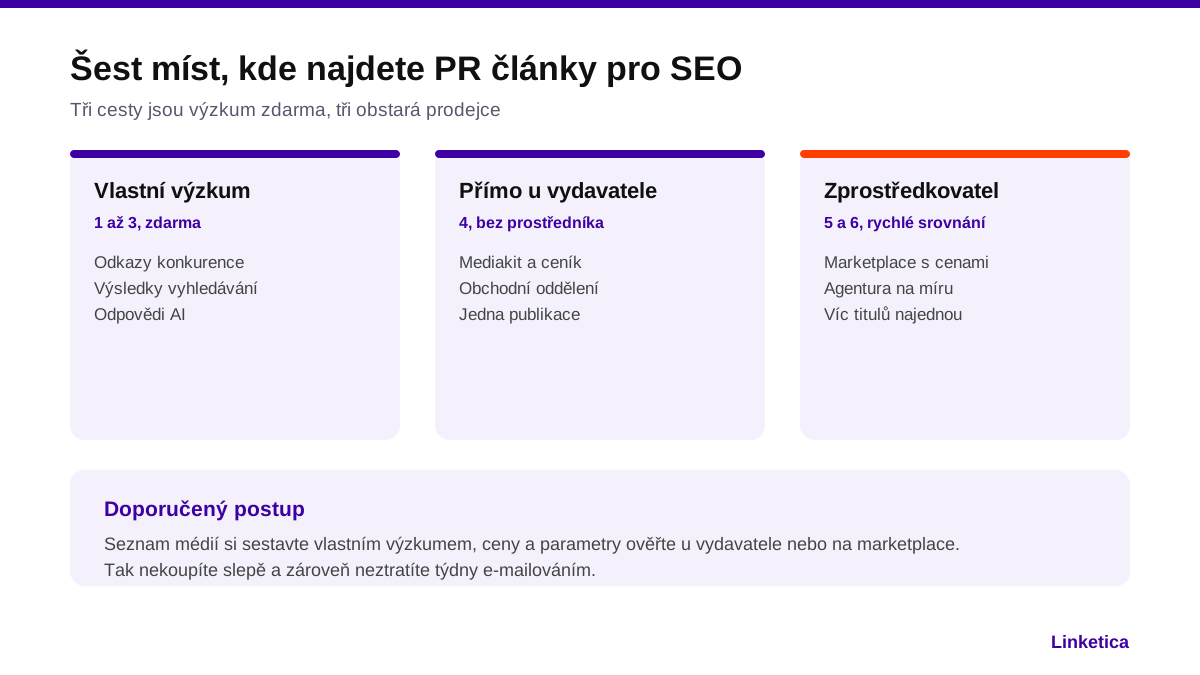
- Pick media by citability, not by DA. Put 20 queries from your niche to the models and watch which titles they refer to. That is your shopping list.
- Do not buy one channel. The media mix should also cover the places models cite from the most – independent reviews, industry discussions, overview pages.
- Measure the right metric. Not clicks from the article, but the share of answers in which the model names you on a fixed set of 20–30 queries, measured monthly. And alongside it branded search and direct visits.
What follows from it
Buying links and mentions in editorial articles is not a shortcut to being cited by AI – paid content is minimally represented in citations. It is, however, a legitimate and measurable way to get into the text space citations arise from: to broaden the number of places where your brand is named in connection with what you sell. This effect the data supports; it just cannot be bought in the form of a hundred cheap publications. Title selection, text quality and patience decide.
Summary in five sentences
- A paid article rarely becomes a source under the answer. That is no reason not to buy it – the model lists few sources but remembers plenty of names.
- What counts is your name in the text. The brand mention is the strongest signal of all in the data, stronger than the link.
- One article in the right medium beats ten cheap ones. Similar cost, incomparable result.
- The effect counts in months, not days. Whoever knows that up front is not disappointed.
- Measure what matters: whether the models name you. The same 20 questions once a month suffice.
And one piece of good news to close. In classic search a smaller brand practically cannot catch the big players – they have years of head start. In AI answers it is not so: models do not choose by ranking in the results but by what is written about whom where. It is the most open situation marketing has seen in the past ten years. What decides in it is not budget size but selection – and that is free.
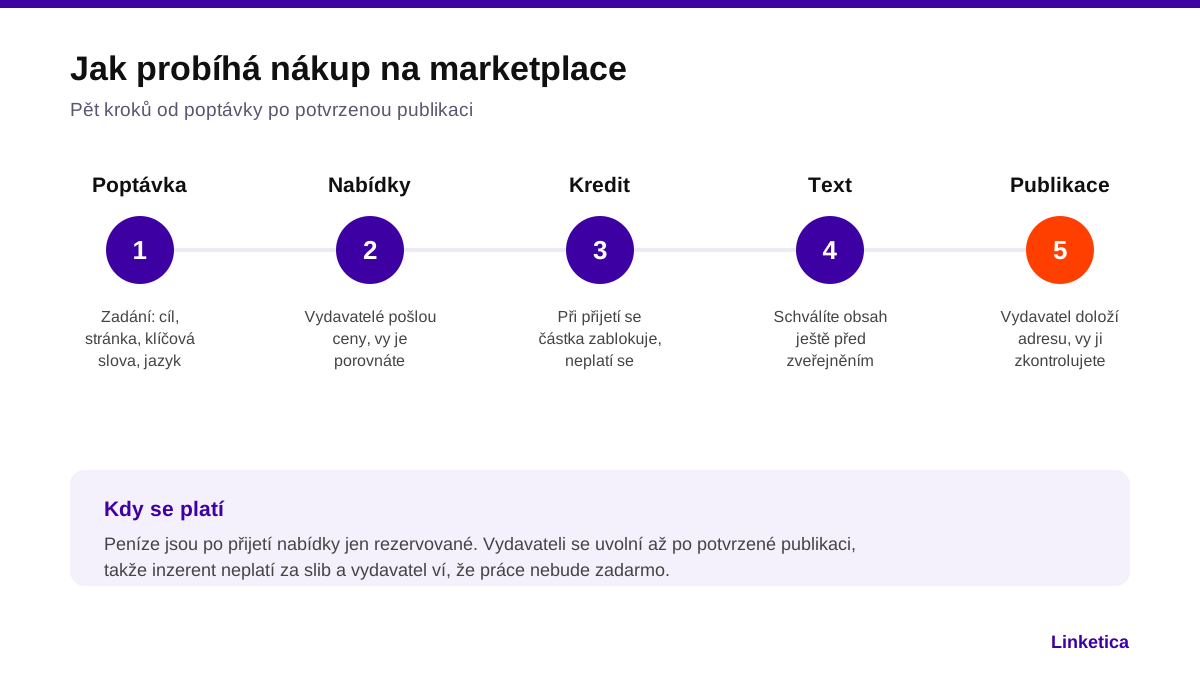
That is exactly why we build Linketica as a marketplace where you see parameters and price for every medium up front: you can compare titles by relevance and readership, order the publication in one place and have a record of what you bought. The decision where to invest stays with you – you just make it with numbers on the table instead of by the offer that came by e-mail.
Časté otázky
Is there a study proving that bought links raise AI visibility?
Does AI cite paid PR articles?
Is a mention without a link good for anything?
Do I lose value if the link is labelled rel="sponsored"?
What is the biggest risk of buying publications?
How do I know the purchase worked?
Zdroje a doporučená literatura
- Muck Rack – What Is AI Reading? / Generative Pulse (květen 2026, 25+ mil. odkazů citovaných AI)
- Ahrefs – An Analysis of AI Overview Brand Visibility Factors (75 000 značek, 2025)
- Ahrefs – korelace značkových signálů s viditelností v ChatGPT a Google AI Mode (prosinec 2025)
- Aggarwal a kol.: GEO – Generative Engine Optimization (KDD 2024)
- Indig & Semrush – How AI Really Weighs Your Links (1 000 domén, 35 000 datových bodů)
- Google Search Central – zásady proti zneužití reputace webu (site reputation abuse)
- Google Search Central – kvalifikace odkazů (rel="sponsored", "nofollow")
Zjistěte zdarma, jak vás vidí AI
Nechte jméno, e-mail a telefon a odemkneme vám online audit AI viditelnosti + checklist „Doporučuje vás AI?“ ke stažení.
Chcete rovnou nakupovat PR články a zmínky? Vyzkoušet Linketicu · Nezávazná poptávka na míru
Zadáním kontaktu souhlasíte s jeho použitím pro zpřístupnění auditu a zaslání tipů. Údaje nepředáváme dál. · Linketica.com